Our History
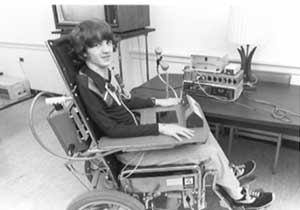 The History of PRC-Saltillo IS the History of alternative and augmentative device technology.
It all began in the early 1960's when Barry Romich, a freshman engineering student at Case Western Reserve University, met Ed Prentke, an engineer at Highland View Hospital in Cleveland, Ohio. The two men soon found they had a similar mission: to help individuals with disabilities. Prentke and Romich decided to form a partnership and, in 1966, the Prentke Romich Company (PRC) was born.
1960s
- 1966: Ed Prentke and Barry Romich meet and form Prentke Romich Company.
- 1969: PRC produces its first communication device, a typing system based on a discarded Teletype machine.
1970s
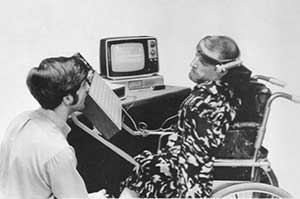 1973: PRC moves from Barry's basement in Madisonburg to its first facility in Shreve, OH.
- 1975: The Veterans Administration orders a large quantity of Automatic Dialing Telephones, for users to make and receive telephone calls. This order gives PRC the boost it needs to grow.
- 1975: PRC welcomes the ECU-1, a 14-channel scanning environmental control device that permitted control of external devices.
- 1979: The Express 1, a microprocessor-based communication device, is developed.
1980s
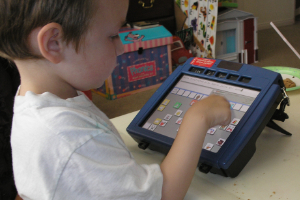 1982: Prentke Romich teams with Bruce Baker of SEMANTIC COMPACTION® to incorporate the MINSPEAK® vocabulary in PRC devices.
- 1982: The Express 3, the first device with synthesized speech capabilities, is introduced.
- 1983: The MINSPEAK 1 (a repackaged Express 3 with MINSPEAK) is officially introduced at the 1st MINSPEAK Conference.
- 1984: The Touch Talker, the first portable device from PRC, debuts.
- 1984: The company moves to its present location in Wooster.
- 1985: The LightTalker begins production. The device introduces a streamlined, tethered headpointing system for users unable to use their hands for access.
- 1986: Liberator, Ltd. is formed in the UK, with PRC owning half interest.
- 1988: PRC enters the digitally recorded speech arena with IntroTalker.
- 1989: Prentke Romich Europe is formed.
1990s
- 1990: Prentke Romich Deutschland is formed.
- 1993: PRC receives U.S. Department of Education grant for Unity® development. This gives the company the ability to develop new language systems.
- 1995: As a result of the grant, PRC launches Unity®, the foundation for the vocabulary in most PRC products.
- 1996: Saltillo, a sister company to PRC, is created.
- 1997: PRC begins sponsoring the annual lecture at the American Speech-Language Hearing Association (ASHA) conference. The lecture is renamed to honor Edwin and Esther Prentke.
2000s
 2000: The Pathfinder, the first product to introduce an LCD touchscreen as part of the device, launches.
- 2001: Desktop Editor, later renamed ChatEditor, is released by Saltillo. The program allows users to run language configurations on a computer without needing a device.
- 2001: The Vantage, the first all-touchscreen device, is introduced.
- 2001: Saltillo launches ChatPC, the first dynamic screen palmtop.
- 2005: The ECO-14, with Windows accessibility, email and Internet capabilities, is released.
- 2006: In Australia, PRI Liberator Pty Ltd is created. In 2007, the company is renamed Liberator Pty Ltd.
- 2006: PRC receives ISO certification.
- 2007: PRC launches Language Acquisition through Motor Planning (LAMP) therapeutic approach workshops.
- 2008: PRC acquires Saltillo.
- 2008: PRC becomes a 100% employee-owned company.
- 2009: PRC launches the AAC Language Lab® as a resource for parents, teachers and clinicians to encourage language development.
- 2009: ALT Chat is released by Saltillo. It is the company's first larger dynamic screen device. This marks the first product collaboration between Saltillo and PRC.
- 2009: The Center for AAC & Autism is established to promote Language Acquisition through Motor Planning (LAMP).
- 2009: The ECOPoint, the first device to utilize an eye-tracking system, is released.
2010s
- 2010: The Essence® family of languages, with a vocabulary designed for literate adults, is introduced.
 2010: TouchChat, Saltillo's first app, is introduced to the marketplace and is the first app released by any speech-generating device manufacturer.
- 2012: PRC releases its first app, LAMP Words for Life.
- 2012: The Accent® 1200 is introduced. For the first time, PRC no longer manufactures devices, instead starting with an external product.
- 2012: NuEye®, a state-of-the-art eye-tracking system, is released.
- 2012: Saltillo introduces the NovaChat 7, the first Saltillo device to run on the Android operating system.
- 2014: Realize Language™, an innovative, online data-monitoring services is brought to market.
- 2015: PRC releases CoreScanner™, a progressive vocabulary program for switch users.
- 2015: NuPoint®, a head-tracking system for those with limited hand use, is introduced. The module is able to be used on all PRC devices as an additional feature.
- 2015: PRiO®, an iPad-based communication tool, featuring the iPad Air and LAMP Words for Life language system, debuts.
- 2015: Saltillo debuts ChatFusion 10, the first fully custom, dynamic screen device.
- 2016: PRC celebrates its 50th anniversary.
- 2019: Dave Hershberger, CEO of Saltillo, is named CEO of PRC. Under his leadership, the two companies, PRC and Saltillo, merge to become PRC-Saltillo.
2020s
- 2020: PRC-Saltillo’s first two co-branded products are released: the Bluetooth®-enabled AeroSwitch™ and Via™ Pro iOS SGD
- PRC-Saltillo acquires all of the intellectual property (patents, trademarks, and copyrights) related to Minspeak and Unity from Semantic Compaction Systems, Inc.


 Communication Solutions
Training & Implementation
Funding
About Us
Contact
Support/Service
Find an AAC Consultant
Search
Communication Solutions
Training & Implementation
Funding
About Us
Contact
Support/Service
Find an AAC Consultant
Search